It’s been over a year since I’ve had the boys at home, and in the past year I have learned things I never thought were even a thing. I never thought about these things because someone else was always managing my horses. I thought it was simple: Give your horses hay. Give your horses grain a few times a day. The end. I was SO wrong.
Did you know, certain (many) feeds contain ingredients that can cause an inflammatory responses in some horses? Feed quality affects body condition, hoof quality, and energy levels? Hay type and quality affects what types of feeds/supplements are needed to “balance” a horses diet for best body/hoof condition? Calories matter, weights of hay flakes matter, the amount of those hay flakes that are actually consumed matters. The amount of work they are doing daily matters. If you are feeding a supplement that you think is helping (hoof supplements come to mind) but your horses feed and hay combined already have the amount of those ingredients the horses body can absorb, you are literally throwing money at a problem and that money is being turned directly into manure. What a waste, right? Who knew? Well, apparently a lot of people, but I wasn’t really one of them until recently.
I have 2 horses with “less than ideal” hoof quality, as I have previously posted about. I have one that is a consistent tail rubber-and I have tried SO many things to get at this over the years EXCEPT changing the way they are fed. Up until last year, I really didn’t have much of a say in how they were fed as they were being boarded at other locations. As a means to an end with some recent issues, the investigation and research began as to how I can make an attempt at really fixing these issues. The resounding internet research, however reliable or unreliable it may be, was DIET MATTERS-and a proper diet can help with many issues. Now that they are here in my back yard, I DO have a say and I CAN try new things. So, here we go.
Lets think about how horses are designed. Their bodies are designed to “graze” most of the day (16-20 hours) and sleep very little. As such, horses are not meant to go long periods of time without food. Most of my research says 3 hours is the maximum you should let your horses go without ingesting some form of food, since the amount of stomach acid they produce constantly (for the grazing lifestyle their bodies are designed for) can cause a multitude of issues (ulcers, hindgut acidosis, behavioral problems, etc), many of which we battle with horses living a domesticated, performance lifestyle. This means they are stalled, and fed a few meals a day with a few flakes of hay at those meal times. This means they do go long(er) periods of time without food, depending on how fast they eat.
The average horse needs to eat 1.5 to 2.5 % of it’s body weight a day to maintain it’s weight. Say a 1000 lb horse is fed a grain meal at 7am and given 2 flakes of hay. Then dinner at 5pm, same feeding-a grain meal and a few flakes of hay. This is a typical feeding for many large barns. Assume 6 lbs of grain daily which is mostly the recommended amount to get the full nutrient content required, and each flake of hay weighs somewhere around 5 lbs, totaling 20 lbs per day. Assume your horse is going to waste some (if my horses are fed hay free choice on the ground of their stalls, they eat about half of it and use the other half as a toilet or extra bedding). So, that leaves 10 lbs a day of hay and 6 lbs in feed, and long periods of time in between feedings means if your horse does not “ration” it’s hay then it is without food for much longer than the max amount of time it should be. Not ideal, right?
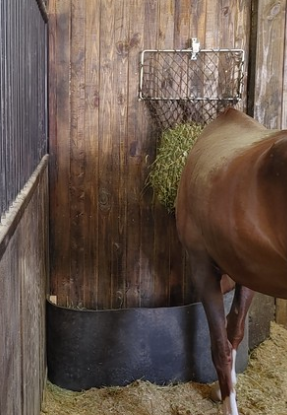
My feed setup is such that they get “free choice” hay in a contained area made with a piece of stall mat and also hay in a slow feed net (pictured below). If I fill both, it lasts them about 24 hours. One of mine leaves very little waste, and the other eats about 50%. I give his remaining 50% to the hoover/hippo, and refill both, about once a day or as needed. When they came here, I began feeding a high quality fortified complete sweet feed at 6 lbs a day split into 2 feedings morning and evening with 24/7 access to hay plus supplements for hoof quality and gut health once daily. The hoover got so fat over winter that when it came time for them to ease back into work in early spring, I didn’t have a girth that fit him! His grain got backed off to about 3 lbs a day. With that though, I began thinking about how he wasn’t getting the nutrients he should be, considering the recommended feeding for the complete feed was 6 lbs to get the complete nutrient amount for a day to make it “complete”. His weight improved with less grain, but his hoof quality has suffered over the last several months. Is it attributed to the reduction in feed? Who knows. Oh well… live and learn. Try, try again. Keep going. It’s all we can do.
About a month ago I decided I was going to switch to a forage based diet instead of feeding grain (fortified sweet feed) which is known for the inflammatory responses I mentioned earlier (maybe this is causing the tail rubbing? Maybe not but it won’t HURT it to try it and if it helps, bonus!). Now, they are completely off of the old fortified grain and easing into 1 meal a day of the following: 1 lb of a ration balancer mixed with soaked alfalfa cubes. Currently they are still getting their old hoof and gut supplements until those run out, then they will be switched to the new supplements I have decided on-one for gut health and one for bone and joint support (which is supposed to help hooves and also joints-if it works like it says). They will get an evening ration of soaked alfalfa cubes only, with added electrolytes to encourage more water intake when needed. My picky eater who wastes half his hay gets rice bran oil added to his morning and evening feeds for maintaining weight. The hippo skips this part. Both of them are transitioning well, but I have a feeling it’s the soaked alfalfa cubes encouraging them!
The up side to this is, IF either horse had inflammatory responses to the fortified sweet feed, that should go away with the new feeding program. The new feeding program will also be less sugary, so any issues that could develop where a horses sugar and starch intake would need to be monitored, would already be lower than the previous feeding routine and not much would need to change. Metabolic issues in horses can develop at any time, but even if they have not been diagnosed with these types of issues it seems there are still a lot of benefits to feeding a low sugar, lower starch diet to horses.
To be totally transparent, I have not had my hay tested so I do not completely know if they are getting a 100% balanced diet. However, I do know the average contents of the type of hay I am feeding and the contents of the ration balancer and it’s close enough. Will I potentially need to adjust the amounts? Yes. Will I maybe need to add other things? Yes. Will it maybe work out to be perfect as-is? Maybe. Will it change as the seasons turn? Also yes. Managing horses is an ever-evolving situation and something working today may not always work until the end of time. You have to be open to change. You have to be willing to research. You have to try your best. At the end of the day, most people managing horses are doing the best they can with their unique situations. None of it is the end all, be all, best possible way for every individual equine. I’m just over here trying to do what I feel is right for mine.
Since this is the first week switched 100% to NO fortified sweet feed, I have taken measurements of their girth to estimate a weight, and will do so weekly for the foreseeable future so I can keep a closer eye on how they are maintaining weight. I want to be quick to catch any drops so I can make any needed adjustments quickly. It’s harder to put weight on a horse than it is to take it off.
Later, I may add reviews on the new feed products and supplements after I have had a chance to see results on those. I am cautiously optimistic at this point and just praying I am making the right decisions. If not, I can always change it… again. Now, if I could only put so much effort into feeding myself! Yeah, not going to happen, but it’s a nice thought.

 Twisted Sisters Saddlebreds