A subject you don’t find details on often, because it varies greatly from horse to horse and location to location. However, it’s something anyone looking to own a horse or multiple horses needs to consider in detail before purchasing and deciding how/where to keep their horse(s). This will vary by area and cost of hay and other items in your area, but we are in Kentucky, and these costs are based on that. I encourage anyone looking at this to research costs of hay, feeds, and other items in their specific area so they can add up costs specific to their location. I am an advocate for transparency in the horse industry, so I am sharing my specific costs as a way to help others put a dollar amount to basic horse ownership. If you know up front, you’ll be better prepared to maintain your horses and not get into a situation where you can’t keep up with their basic needs.
If you are boarding and think the monthly boarding fee is outrageous, consider what is included and everything you do not personally have to do no matter if you are healthy, sick, injured, tired, busy, etc. The actual dollar amount is not indicative of the actual cost of boarding.
In the case where you’re doing it yourself “at home”, here’s what you’re going to be looking at as a SIMPLE feeding plan cost for a 1000 lb easy keeper who requires no supplements or “grain” to maintain weight. This is the base of my feeding program and equates to around $1700 a year for one, approximately 1000 lb horse. This assumes they need NO GRAIN and NO SUPPLEMENTS, which, 98% of the time is not the case. A ration balancer, at minimum, should be fed to ensure they get the right balance of minerals for their body, skin, hoof, and other health needs.

Any feed or grain needs to maintain a healthy horse or preferred supplements (as either required or preferred) of course add additional cost to any feeding program. Most competition horses of average age will require some form of maintenance in the form of additional feed and/or supplement(s). If you have a growing foal, pregnant mare, horse in hard daily work, or a retired pasture puff /horse otherwise not in work, their needs will be very different and based on each individual.
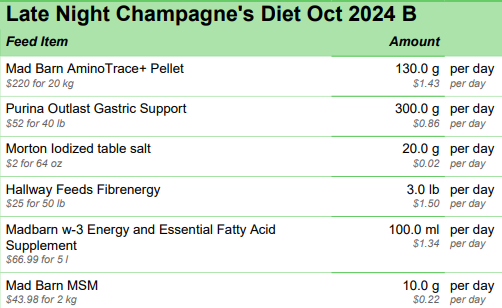
Below is a complete representation of what they are currently being fed (and doing well on) and the costs involved. Note this is the Fall/Winter costs (Oct-March). Every year when I get a new batch of hay, I have our local extension office come out and pull samples to send for testing. Once I have the testing numbers, I use FeedXL to balance their supplements to fill the gaps where their hay/forage is lacking. It’s not 100% accurate, but it’s a less expensive alternative to hiring a nutritionist and it’s easier than learning how to calculate all their needs myself.
Also to note, April-Sept they are on a product called Multifly to control the fly population and keep them (and us) more comfortable. We started this late in 2023 (In July) and I will possibly do a review later but it WORKED so we started it in April 2024 and continued through October. That adds approximately $10/monthly per horse.
So, all in all, these 2 horses cost me approximately ~$7000 combined annually to feed assuming nothing changes. This is ONLY what they EAT.
Am I certain there are cheaper ways to feed? Yes. Could I probably cut out some of the extras (oil, etc) also yes. But I feed what I prefer for the results I want to see and the performance I expect to get out of my horses and this is what is working for us. I have changed a lot of things over the last 3 years to find what works for me. It may not work for everyone and there are a ton of products that may work just as well, or possibly better. This is where we are right now. It’s subject to change. As long as my horses are happy and healthy, have shiny coats and quality hoof (which lets face it, has been a struggle for us in the past) I will be satisfied with their feed program and not likely to change much.

If you’re interested in overall cost of horse ownership, factor in every approximately 6 week trims/shoeing, minimum of once a year vaccines/wellness exam (most veterinarians require you to be a current client in order to address any emergencies/after hours needs), a contingency amount for any emergencies that may pop up, and insurance on your animal(s) if you so choose, etc.
- Annual Wellness exam with necessary vaccines, dentals, sheath cleaning, coggins, state health certification, etc. from my vet is approximately $1200 for both horses.
- 4 foot shoeing with my farrier is $120
- This is assuming they have no special shoeing requirements (corrective shoeing, pads, etc), and I don’t have to call the farrier back to put shoes back on during their cycle, which can add cost.
- Barefoot trims are $60 (I let them be barefoot in the winter if at all possible)
- I pay an annual premium of approximately $1200 for both horses to be insured (Major Medical and Mortality)
This is assuming the horses are kept on your property, and not considering any improvements, maintenance, or other costs associated with having them there such as halters, lead ropes, fly masks/sheets, turnout/stable sheets and/or blankets, coolers, shampoos, brushes, bridles, saddles, or any other tack/equipment necessary.
Lets assume for the sake of easy math, they are shod year round, have no medical emergencies, and require no additional medical/health maintenance. To feed and maintain very basic care of 2 healthy horses, it costs me around $10,500 annually, which is about $875 per month.
- Feed – $7,000
- Vet – $1,200
- Farrier – $1,100
- Insurance – $1,200
- Total – $10,500
 Twisted Sisters Saddlebreds