AOT

Comparison is the Thief of Joy

Do you ever look at your horses and think “you could have been so much more, if you weren’t just stuck with me?” Do you ever compare where you and your horses are to where other people and their horses are and think “we aren’t doing enough” and get a little upset at that?

So many times I flip through magazines and I see all these people and horses in tip top shape doing all these big things and I get a little down. I lose motivation and I lose some faith at times. I look at my knowledge and skill level for training, I look at the talent and natural ability of my horses and I think, they could have really gone to the top. I look at them in awe of their natural abilities, in awe of their tolerance and forgiveness for me, and I wonder what they could have done under a compassionate, more skilled teacher. I look at other horses that maybe aren’t as naturally talented working and showing under very talented trainers and doing big things and I think “that could have been my horses” if it weren’t for me. If only I had more money to pay someone to help them, to help me. If only I had more skill, more talent, more, more, more. It is so easy to feel guilty in the horse world, to feel like you’re not enough, you don’t have enough, aren’t doing enough. It’s so easy to downplay your accomplishments because you are too busy judging them against others.

But, isn’t that part of the problem with the horse world anyway? Isn’t this supposed to be FUN? Sometimes I have to force myself to take a step back. Maybe even a lot of steps back and look at my horses; Horses no one wanted because they were labeled “problematic” among other things, due to being under the direction of people who didn’t believe in them, pushed them too hard, had expectations beyond the horses skills, didn’t have enough time for them due to other responsibilities, etc. I have to look, I mean really look at how far they’ve come with only an amateur to teach them. I have to look at myself, where I started to where I am now and the skills I didn’t have in the beginning that I have learned over the years. When I really look at all I have learned since I began my AOT journey, not only out of necessity but also out of sheer determination, then I can see my horses have overcome so many hurdles and proved so many things people have said about them wrong. I have done the same myself. These horses have excelled because I have not given up on them when others did. I have made it a point to learn from anyone I can, find answers any way I can, and I have kept that “try, try again” attitude through setbacks, through failures, through all the highs and lows that come with working with horses. I have to meet them where they are, praise them as they stand, and be proud of how much we have done with so little.

At the end of the day, the horses don’t care. They are happy to stand in a field and eat grass and hay and they are happy to be loved and fed and cared for. THey could care less if we go to a horse show. They could care less what anyone thinks. They are happy to have someone kind to help them learn skills they didn’t even know they needed. They are truly and honestly GOOD boys who try so hard. So what if they could have done more? Others with more skills than myself could have done more for them, but they didn’t. They could have ended up in bad situations but instead, they landed with me: The determined amateur. And I won’t stand for ANYONE to talk poorly of my good boys, even if we accomplish absolutely NOTHING. So, why would I stand for myself looking poorly upon our accomplishments? I need to learn to use that at motivation as we ramp up into show season. There’s always things to learn and always fun to be had.

Comparison is the thief of joy. Learn to be happy as you are, and if you want more, go WORK FOR IT!

Horses at Home-A One Year Review

Those of you who have been following this for a long time probably remember the posts here about bringing the boys home. Can you believe it’s been (over) a year now? I can’t. What do they say? Time flies when you’re having fun? Or having… all the work to do? Or something like that.

I have managed to keep my horses alive and major incident free for a year. By major incident I mean we have not had any significant health problems or issues and we have needed little vet care but I don’t mean we have had zero issues. You guys realize my horses are animals with a sense of humor that love to watch me squirm and panic, right? So here are the things I have learned over the past year having horses at home.

  • Having horses at home is an absolute blessing and it’s so cool to just watch them live, breathe, eat, etc.  There’s nothing like the sound of horses happily munching hay.
  • If you should be blessed with horses that have as much personality as mine, you could likely create a youtube or something and make money off their antics.  I am not that creative, but I have thought about it.  They are hysterical and I laugh, a LOT.
  • You better prepare yourself to fill your entire phone with photos and videos of all the things they do.  Or have some self-control, which I do not possess when it comes to them (or the dog, for that matter).  Zero pictures of the husband and I.  ALLLLLL the pictures of the horses and dog. 
  • If you haven’t spent time in the barn in your pajamas or bath robe, you’re probably doing it wrong or haven’t had horses at home long enough.    
  • You will 10000% spend more time working in the barn and managing the horses than you will riding or working the horses
  • Barn chores wait for no one.  It doesn’t matter if you are busy, sick, hospitalized, out of town, or just lazy, etc.  The chores still have to get done.  Someone has to do them.  If you can’t, you better find someone who can.
    • Going out of town is a thing that requires much planning and effort, and you will worry the whole time about your horses.
  • Horses are accidents waiting to happen. 
    • Pro tip: get annuals to keep in good standing as a current client with a vet.  Otherwise, you may not be able to get care in an emergency.
    • Don’t think you are above having an emergency. Your horse(s) will prove you wrong. 
  • They WILL get loose at some point. Have a plan. Or run around like a complete fool trying to contain them. I’ve done both.
  • Your barn will never be clean. Ever. Horses are gross. You will never 100% get rid of all the dust or grime they bring.
  • Take all the things you thought you needed, and add more things you never knew even existed.  Then you still won’t have everything you need for horses. 
  • There is no such thing as too much tack or too many bits. 
  • A leaf blower has many uses far and above blowing leaves, and is a great thing for barn use
  • Cobwebs.  They refuse to go away no matter how many times you swipe them down with a broom.  Just, WHY?
  • Your permanent accessory is now hay.  Hay in your hair.  Hay on your clothes.  Hay in your pockets, down your pants, in your gloves, in your boots, in your underwear, literally everywhere. Feel something stabbing you in the middle of the night in your bed?  Hay. How did it even get there?  Hay goblins-I don’t know.  But it does. 
  • If your horses wear shoes, it will take an act of God to keep them on if they are on lots of turnout.  But lots of turnout is good for their brains.  It’s a double edged sword. 
  • Speaking of shoes, pray for a good farrier.  A consistent one. A true horseman who won’t charge you a zillion dollars, but also treats you and your horses well and SHOWS UP when you need them.  Level of difficulty: Expert.  Godspeed.  Finding that unicorn is near impossible. 
  • You can never have enough hooks to hang things on in a barn.  Or enough bins to organize things.  And somehow, with all the organizing tools in the world, you’ll still manage to leave things out of place.  It’s OK.  You have bigger problems. 
  • Never underestimate a good pair of gloves. Or a good 10 pairs, because you’ll use the snot out of them and even the nicest pairs will eventually fall apart under barn use. Hay string spares no glove. Nothing else does, either. And for the love of God, don’t waste your money on cheap work gloves. Your hands will thank you.

I am sure I could think of a million other things.  But for now, it’s time to go back to enjoying watching my horses exist. As much of a pain as they are, they make my days every single day.  Sometimes they make them frustrating, but they always make them happy because I am one lucky lady to get to experience life with them right here with me. 

No One Sees the Magic

There are good days and bad days working horses.  It’s always the great days that no one sees and there’s no evidence of.  I am beyond lucky to have 2 very special, talented horses to work even if no one sees their best days but me. Ideally, their best days would be at a show, in front of God and Country and everyone else, but alas, we are rarely that lucky.

As an AOT,  it’s been a very difficult road (with a stint somewhere in the middle where I just about gave up) but I have learned a lot in 10 years. People have asked me how I do it.  Well, honestly, I didn’t know I had another choice. I can’t afford $2,000-$3,000 a month for professional training (the going rate here in KY is between 1,000 and $1,500 per horse). This doesn’t include any farrier, vet, or other needs. It’s also well above what we pay for our mortgage so… yeah. We are not in a financial position to pay more for horse training than we do for a home to live in.

When you don’t have money but you have work ethic and an undying stubbornness inside of you that refuses to give up, you can create your own 5 figure horses out of next to nothing. Granted, they may not be the best of the best, they may not ever be world champions, they won’t win every class they are entered in, but they are FUN. They are (Mostly) SAFE. They are talented. And if I were to go out and purchase horses of this quality at their current training levels, they would NOT be cheap. Even with their quirks.

$500 horse on left, “free” horse on right. However, just because they didn’t cost much up front doesn’t mean they haven’t cost. They have both had a LOT invested into them. They are worth every ounce of frustration, financial hardship, time, and sanity that I have invested into them.

Update on Fiz’s training!

Fiz has been at a professional trainer since March 25th. He’s there almost through the end of April. There have been some big changes in his life during this time period. He is used to living in a pasture, and only coming in to work, then going back out. He lives in a stall the majority of the time at the trainers place. He is used to being worked only about 4 days a week. He is getting worked 6 days a week at the trainer. He’s used to amateurs who fly by the seat of their pants and lack professional training knowledge. Now he’s being worked by a professional who has a clearly defined training method and structure.

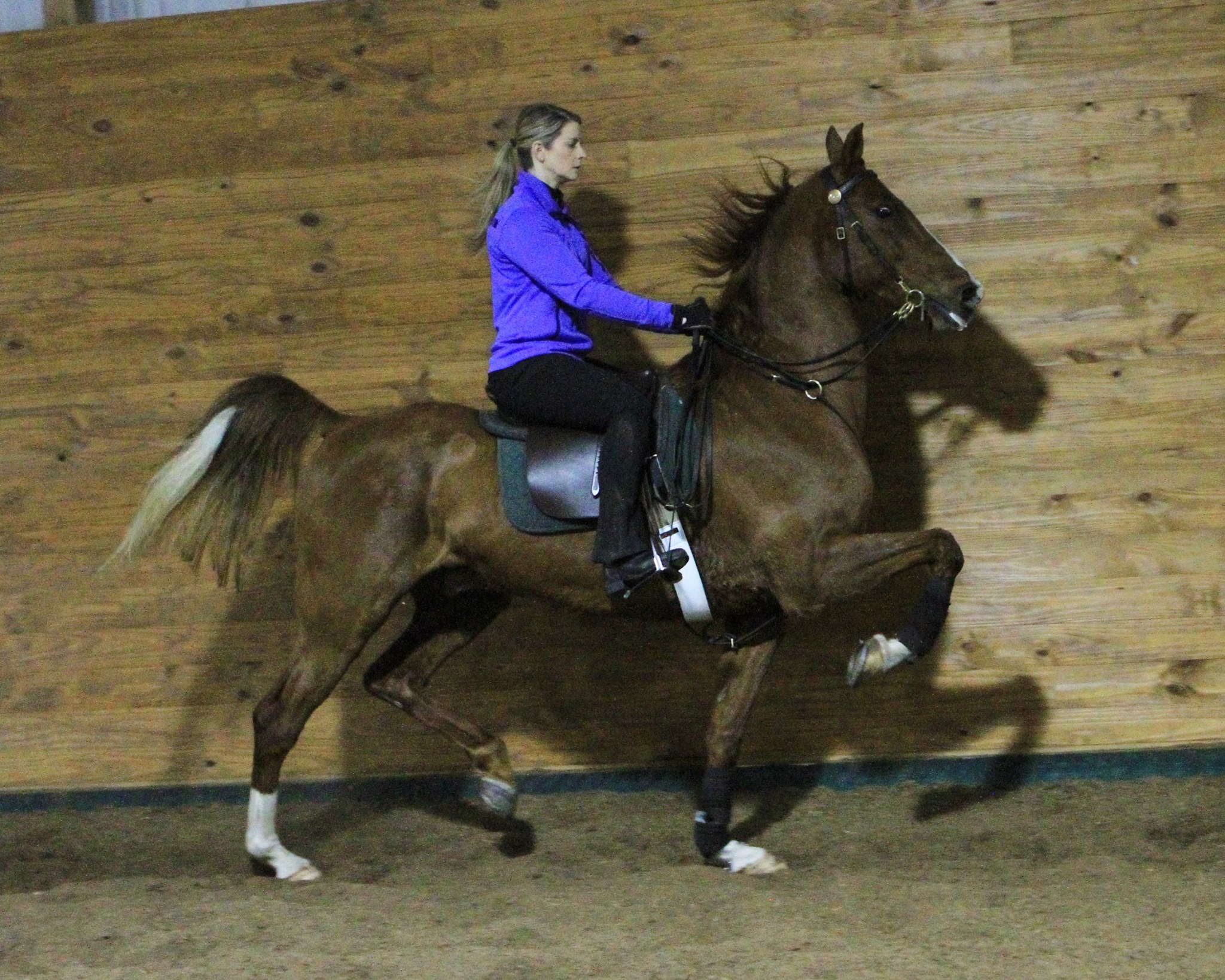
Today, April 14th, he’s been with the trainer for about 2.5 weeks. I got to ride him for the first time since he has been there. Cindy rode him on Saturday, and had a really great ride. I would like to talk about some of the things I noticed with her ride, and some of the things I learned during mine. I will also talk about some of the training advice we have gotten and how it differs from the ideas we previously had.

First, let me say this. He is much improved in several areas. Below, I’ll take you through the gaits and what advice has been offered for each.

#1, The Walk
Flat, straight, and patient. Make him walk straight up into the corners and make the arena square. Make his shoulders and his hips walk inline with each other, and make sure as you are walking to push him up to the bridle so he has to take ahold of it. Do not pull. Hands steady, and in the same spot. When he takes hold, give. Just a small release of your fingers, but keep pushing with your leg making him walk up to the bit.

#2, The Trot
A country pleasure horse needs 2 trots. The pleasure trot and extended trot. We knew this, but previously Fiz would get mad when he was asked to go faster and he would break into a canter without ever actually going faster. It’s better to have only one speed than have to break, so that’s what we used to do.  A pleasure trot needs to have energy, it needs to cover ground, but it also needs to save room for max trotting speed at the extended trot. Same principles apply as the walk, use a lot of leg, push him to the bridle and make him take hold as he moves forward. Music to my non-equitation body type and mind frame was, let your legs hit him in the sides and even flop around on him some. Apply pressure, keep him moving forward and pushing from the hind end. He is expected to move from the back to the front, pushing off his hind to give his front momentum. Always keep the whip right against his shoulder.

When you ask for the extended trot, cluck, then squeeze (don’t kick) and if he doesn’t move on, give a slight tap with the whip on his shoulder. Not a whack, a TAP. If that doesn’t do it, growl at him and tap again. He has learned that he has to move on and not break into the canter. That doesn’t mean he will never break. If he does, don’t stop! Keep cantering. Teach him that it’s more work to do the wrong thing than the right. Rest assured, he will find his trot after enough of making him go and go, and you will find the sweet spot where you have hit max trotting speed before he has to canter. If you really want to find good separation, work him at a pleasure trot, then extended trot, and bring him back down to a pleasure trot. Even if just for one rail, you try to find that max speed, really ask him to step up, then come back down to the pleasure trot. Keep the energy and the go forward all the time. Do not forget about contact with his mouth (keep this in mind at all gaits) and do not forget that reward of giving when he takes a hold on his bridle and moves on forward. Always give him that reward.

#3, The Canter.
His canter cues are more clearly defined and he is learning the expectation for getting and keeping the correct lead both directions of the ring. Previously, we thought each time he took it wrong, we should stop and ask again until he got it right. This method had taught him if he does it wrong, he gets to quit. The new method is, no matter which way he takes it, do not let him stop. Make him GO. And go, and go some more. Teach him that just because he does something wrong, he does not get to stop and quit. He’s working no matter what he does, and again, it’s going to be harder when he does it wrong.

The canter cue needs to be very clear. A slight turn of the head (bring the rail rein straight back and at the same time give with the inside rein with a release of your fingers), rail leg, and SPEAK the word “Canter” to him. Speak the word EVERY TIME you ask for the canter. Do not be afraid to be vocal. IF he runs sideways when you turn to canter, DO NOT let him canter. This is unacceptable behavior that will be punished by forcing him back to the rail and to walk straight, and patiently, until he is asked again for the canter with the clear signal. This could mean setting him up to canter multiple times, but never allowing him to actually take off. Set up to canter and then go back to straight walking forward on the rail until he doesn’t get all sideways and crooked. Then maybe trot. Do anything else so he loses the train of thought to anticipate cantering.

When cantering, he is capable of cantering SLOW.  Take back on the upward motion, and give on the downward motion.  Give and take, constantly.  And still, SAY the word CANTER, or make a “kiss” sound to him.  Make him canter straight, and do not let him swing his back end to the middle, because this makes it easier for him to swap leads.  If anything, turn his head more toward the middle so it makes it more difficult for him to swap leads or fall out of the canter.  When he does it right, don’t push the issue or make him keep on going. Maybe one or two trips around is good, then quit on a good note.  Remember, make it EASIER to do the RIGHT thing.

12140048_10154166158764444_2067037096436532418_o

Bottom line is, he’s going to make mistakes. The most important thing is to teach him that it’s easier on him to do right than to do wrong. Bad behavior is punished by harder work. Good behavior is rewarded by giving (releasing your fingers) in the bridle and getting to be finished sooner because he did everything you asked and he did it correctly.

Always ask yourself the question: “Am I training or am I un-training?” and if you are not certain, it’s probably the latter. If you can answer that you are training, follow up with “What is this teaching him?” and as long as you are happy with what it is teaching, stick with it. If you’re not, change it up. Think ahead, have a plan, and execute that plan.
Another thing we’ve been taught is that he needs to jog. And jog, and jog, and jog. The more fit he is (which is accomplished by miles and miles in the jog cart) the easier it is going to be for him to do the right things, the easier it will be for him to be able to willingly go forward and move on. We can’t ask him to run a marathon when he’s been working as a sprinter.

Check out this video clip after his first week of training.

A Short Video from Professional Training