Horse

How to Prevent Blanket Rubs

Do you have an impossible horse to fit a sheet/blanket to, but still want or need to use one for some reason or another? A wonderful suggestion from a friend of mine has eliminated Duke’s awful rubbing. Shout out to Emily and her Mom for this tip! Duke is either the worst to fit, has super sensitive skin, or maybe both? Earlier this year (somewhere around the end of June, beginning of July), he broke out in bumps all over his body due to biting flies and/or mosquitoes. To try and fix it, I went out and got the latest and greatest Ultrashield Gold fly spray. It was supposed to be great, as I’ve read and heard great things. Well, it gave Duke massive welts all over his skin ON TOP of the bug bites. Poor thing was miserable and after feeding him zyrtec at the suggestion of my vet, I broke down and purchased each horse a Rambo Protector Integrated Hood (meaning it doesn’t detach) fly sheet. My bank account hates me. It’s always something. Don’t mind me while I go make a withdraw and light it on fire and that’s about how things go around here.

By the way, the Ultrashield Green, their Natural Spray has worked pretty good for us this year during training, doesn’t do squat for turnout though-nothing seems to last for turnout.

Anywayyyy the Rambo sheets fit pretty nice and it was working well without rubs for a few weeks, I was so happy! Then one day I brought them in and noticed it had started rubbing too. Once it started rubbing, within a few days his shoulder was basically raw. I wanted to scream. I may have yelled profanities out loud in the barn. I can put literally anything on Fizz and he is fine. He could wear a garbage can and not have any problems. I could put a billion dollar cashmere and luxury silk sheet (or whatever fine expensive soft fabrics are out there, I’m really no fashionista) on Duke and he’d be rubbed raw within a few weeks.

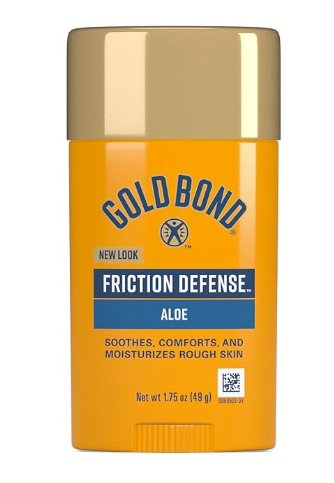
Enter this little stick of awesome. Just rub it on like you would deodorant in the spot(s) being rubbed and voila! I put it on once daily when I put the sheets on in the morning before turnout. They are usually outside sunrise to sunset. His hair started growing back within a week. After a month, it’s fully grown in. It looks a little weird being as the rest of his hair is bleached from before getting the sheets and the patch grew back unbleached black, but there is hair! Hallelujah! It is 9/18 and I’ve used 2 whole sticks at this point from August 8 to now, but that 13 dollars is worth every penny. I might as well buy a few cases of these things at this point.

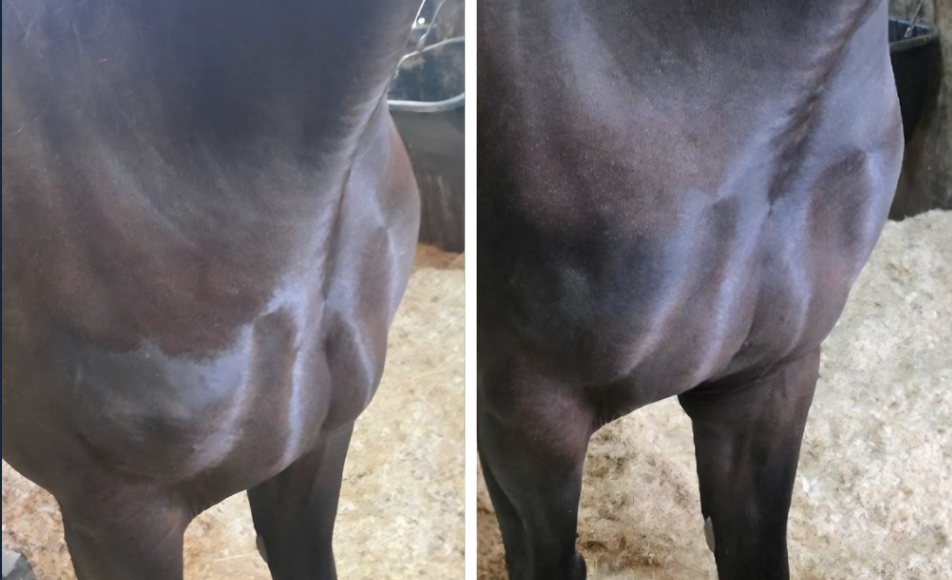
The photo on the left was taken August 7th. The one on the right was taken Sept 6th. The hair has completely come back in.

Just putting this out there, maybe someone somewhere will find this and it will help them and their horses from getting terrible blanket rubs!

Comparison is the Thief of Joy

Do you ever look at your horses and think “you could have been so much more, if you weren’t just stuck with me?” Do you ever compare where you and your horses are to where other people and their horses are and think “we aren’t doing enough” and get a little upset at that?

So many times I flip through magazines and I see all these people and horses in tip top shape doing all these big things and I get a little down. I lose motivation and I lose some faith at times. I look at my knowledge and skill level for training, I look at the talent and natural ability of my horses and I think, they could have really gone to the top. I look at them in awe of their natural abilities, in awe of their tolerance and forgiveness for me, and I wonder what they could have done under a compassionate, more skilled teacher. I look at other horses that maybe aren’t as naturally talented working and showing under very talented trainers and doing big things and I think “that could have been my horses” if it weren’t for me. If only I had more money to pay someone to help them, to help me. If only I had more skill, more talent, more, more, more. It is so easy to feel guilty in the horse world, to feel like you’re not enough, you don’t have enough, aren’t doing enough. It’s so easy to downplay your accomplishments because you are too busy judging them against others.

But, isn’t that part of the problem with the horse world anyway? Isn’t this supposed to be FUN? Sometimes I have to force myself to take a step back. Maybe even a lot of steps back and look at my horses; Horses no one wanted because they were labeled “problematic” among other things, due to being under the direction of people who didn’t believe in them, pushed them too hard, had expectations beyond the horses skills, didn’t have enough time for them due to other responsibilities, etc. I have to look, I mean really look at how far they’ve come with only an amateur to teach them. I have to look at myself, where I started to where I am now and the skills I didn’t have in the beginning that I have learned over the years. When I really look at all I have learned since I began my AOT journey, not only out of necessity but also out of sheer determination, then I can see my horses have overcome so many hurdles and proved so many things people have said about them wrong. I have done the same myself. These horses have excelled because I have not given up on them when others did. I have made it a point to learn from anyone I can, find answers any way I can, and I have kept that “try, try again” attitude through setbacks, through failures, through all the highs and lows that come with working with horses. I have to meet them where they are, praise them as they stand, and be proud of how much we have done with so little.

At the end of the day, the horses don’t care. They are happy to stand in a field and eat grass and hay and they are happy to be loved and fed and cared for. THey could care less if we go to a horse show. They could care less what anyone thinks. They are happy to have someone kind to help them learn skills they didn’t even know they needed. They are truly and honestly GOOD boys who try so hard. So what if they could have done more? Others with more skills than myself could have done more for them, but they didn’t. They could have ended up in bad situations but instead, they landed with me: The determined amateur. And I won’t stand for ANYONE to talk poorly of my good boys, even if we accomplish absolutely NOTHING. So, why would I stand for myself looking poorly upon our accomplishments? I need to learn to use that at motivation as we ramp up into show season. There’s always things to learn and always fun to be had.

Comparison is the thief of joy. Learn to be happy as you are, and if you want more, go WORK FOR IT!

In A World of Yes or No, I vote OTHER.

If you are a Saddlebred enthusiast, own a saddlebred, or have any involvement in the saddlebred industry whatsoever, you have at least heard some rumblings of the mess going on within the ASHBA (American Saddlebred Horse and Breeders Association). That is, unless you’re living under a rock somewhere very remote, then maybe you’re actually better off. I try to keep my distance from drama, but if you’re at all involved, you can’t really ignore everything that is happening. The board, the members, everyone from the “elite” to the “nobodies” and all in between are ready to throw hands over who is right and what is to be done about it. This is, in my opinion, the boil finally coming to a head after many years of festering infection below the surface.

In 2024, the KY State Fair decided USEF should not be the governing body over the World Championship Horse Show, even though the ASHBA had a contract with USEF for the prize programs held within the World Championship. However, the ASHBA does not own the rights to the World Championship Horse Show, the KY State fair does. And so, the Ky State fair did what they do, and said to hell with ASHBA’s contract with USEF and went with another governing body for the show. ASHBA responded by moving the prize programs to the Indianapolis Charity Horse Show in Sept 2024. Many big barns didn’t attend WCHS as a result. From there, it has just spiraled. Some big breeders, one in particular, are calling out the ASHBA on their standard practices and demanding more transparency. As part of that uproar, new bylaws for the association were proposed. I’m not an attorney and I don’t really understand a lot of the lingo or the process, but now it’s coming down to membership casting votes on “keeping things as they are” (NO) or “doing something new” (YES) at the annual meeting in February 2025. Some trainers have posted videos stating their reasons for voting NO, the association has sent out documentation encouraging people to vote NO, and I’ve seen a lot of breeders and members speaking out that things need to change so voting YES is the answer. Both sides make very good points and arguments for their reasoning.

I’m over here thinking everyone looks ridiculous and this is pathetic. It’s all absurd and it is a really bad look for our breed as a whole that the people running the show are all fighting with each other. It makes us look like fools. ALL of us. Worse yet, NO ONE wins. What is most critical is, no matter what, the horses are the ones who lose. The horses, who someone chose a mare and stud and intentionally chose to bring them into the world. The powers that be in the association are too oblivious to even realize all of this bickering is hurting everyone and helping no one. Both sides are so focused on the “who’s who” and the “world champions” that they could give a rats ass about anything or anyone else.

Every chance the Association (and/or the Saddlebred museum-which is yet another conversation) gets they send solicitations wanting donations or for you to attend some exorbitantly priced fundraiser or go to a convention or event in some fancy place hundreds of miles away. And if you can’t? Well, you’re a nobody and you’re part of the problem. Or at least, that’s how it feels.

The other side has been caught stating if there’s not a world champion in every one of their foal crops, it’s considered a failure. Imagine saying those lives, who didn’t ask to be here, are failures because they are not in the top 1% of their breed. That sounds a lot like if humans were to say kids who don’t grow up to become president are failures. That everyone else is useless.

Will the “new” board and “new” bylaws change any of that? I’m still not convinced.

As an AOT who has seen the best and worst of this industry and the people in it in the last 35 years, I don’t even know what to think anymore. In some ways I feel like I should stick with the devil I know, but in other ways, I think a change might be for the better. I love the breed.  Some of the people I have met in this industry are the best I’ve ever met.  Some are literally the worst.  The upper echelon of this breed and the association seem not to want me, people like me, horses like mine.  It’s frustrating and disheartening and there are so many times I just want to give up, but I love the saddlebred and somehow that’s always managed to be enough for me. Even when every turn has an obstacle, every show has politics, many shows come with a price tag I can’t afford, and it gets worse year by year. 

Not to mention the price of a saddlebred coming out of a show barn these days.  Imagine paying for one individual horse what some people don’t even pay for their entire home (over the course of a 30 year mortgage). Then imagine people having one of those for every division for themselves, or their kid, or both and they are paying $1200-$1500 per month each for training, not to mention any other associated costs (shows, vet, farrier, chiropractor, massage therapist, magnawave, and the list goes on and on and on). Hello! The training bill for one horse alone is more than my monthly mortgage payment on a home that didn’t cost a fraction of what one of those horses did. THOSE are the people this industry wants. Those high dollar horses are what this industry wants. The resounding feeling I get is if they aren’t those, they are not good enough. And if they aren’t good enough, they’re thrown away. Shunned. Frowned upon. Thought as “less” and worst of all, forgotten.

Let’s be honest here. The “less than” horses are probably about 75% if not more of the entire population of Saddlebreds walking this earth, and therein lies the problem. Preach you want to grow the breed. Preach versatility. Preach your love for the saddlebred. But then ignore every person and every horse who isn’t showing and winning at the top breed shows and at the World Championship level. Remember, this is the same “World Championship” for this breed promoted as so versatile, where people had to fight tooth and nail to get ONE western class (qualifier and championship) and ONE hunt seat (qualifier and championship) flat class. Then, the same horses show in both qualifier and championship because they take so few they don’t need to eliminate anyone. THEN, “they” act like that was such an accomplishment when there are saddleseat classes of all types and age groups for DAYS. It’s so difficult for the western and hunt horses to even qualify to go there that you basically have to kill your horse, yourself, and your bank account by trotting through every open gate you can get to at every show in the country to even stand half a chance. But that’s yet another conversation.

Something needs to change. I’m not saying the proposed “new” bylaws are the change that’s needed, but over and over again, people have spoken up and over and over again, the ASHBA has changed… nothing. They have continued to cater to the elite people, the elite horses, and “forget” everyone else. People are feeling it and that is where the conflict is.

This past year has been very eye opening and as I said before, it’s not a good look for the breed as a whole from any side. Considering the controversy surrounding our breed, our training practices, the “look” of our horses, how we treat and more importantly how we educate people about our breed matters. As someone who has been involved with the saddlebred since I knew what one was, I still feel like an “outsider” and feel unwanted in the industry I’ve been a part of for the better part of 3 decades. The conflict and divisiveness just pushes me further away.  What do you think that does to people who are looking at the Saddlebred as a potential breed to become involved in? What taste do you think that puts in their mouths? It probably tastes like the soap my mom used to wash my mouth out with as a kid when I said something ugly. Infact, it probably tastes worse.

It’s so sad for the horses. Ultimately losing people like me only hurts the horses in the end. People like me are the majority, and the elite are a fairly small group if we’re being honest. People like me give that 75% a place to go. People like me can’t afford top horses, but would go hungry any day of the week just so some of that 75% could eat well. People like our rescue and repurpose organizations who take in the “not good enough” ones and repurpose them into someone’s best friend, someone’s best lesson horse, someone’s favorite trail mount, the next great eventer, or the fanciest dressage mount, despite those horses being thrown away by their breeders and trainers and despite them meaning nothing to those whose opinions “matter” in this industry.  It seems like the well being of the horses, and having a place for everyone, would be good for everyone. The feeling I get though, is “everyone” isn’t “someone” to the ASHBA and every horse doesn’t deserve to be represented if it doesn’t cost 3 normal people mortgages to buy.

So don’t mind me over here. I am just a measly little AOT, a nobody, sitting here in my modest home with my small personal barn where my 2 throw away horses I train myself live because I can’t afford any different. Myself and my husband have sacrificed and continue to sacrifice a LOT to even afford that, and I realize it’s a privilege. One I am very grateful to have. However, I’m still patiently waiting for the governing association that holds the registration papers for my two “lesser than” saddlebreds to get their shit together; To be better, do better, and practice what they preach. Include us. ALL of us. The world champions down to the throw aways. Embrace all disciplines and encourage everyone. We ALL matter and it’s time that is realized, otherwise, I fear the future for this wonderful breed.

Here’s where I stand, outside looking in at the ASHBA: Look down on “us” if you want, but you know what? That says more about you than it does about us. Ignore the crazy ramblings of a nobody: You’ve been doing it for as long as I can remember. Exclusivity has put your numbers on the decline for years, but isn’t that what you wanted? To be exclusive? To exclude people like us? If that wasn’t the intent, it sure was the result. If you want that to change, inclusiveness is something you should consider. Whatever changes or bylaws supports that, that’s where my vote goes.

All that to say, I vote “OTHER” and why can’t that be an option?

Back to Work

Before I started on my AOT journey many years ago now, I didn’t know all the details surrounding actually working a horse. I understood things like ground work, long lining, driving, riding, etc. But I didn’t know a lot about when to do what and how much was enough, or when was too much. Since having my horses at home, I’ve walked the fine line and in the end, the horses always tell you what they need. At least if you have opinionated dragons like mine! I have also made it a point to give them some down time after show season is over. This gives them time to be a horse, to get dirty, to play, to have fun, to rest, and many things that I feel are good for their bodies and brains. We may do a little ride here or there, a trail ride thrown in on a random weekend. Some fun stuff, but no serious work. 

Now that it’s the new year, and the icepocalypse and snowmageddon that beat us down the first part of January is finally starting to melt, it’s time to start thinking about our upcoming show season. For us will probably start in April or May. When you’re starting a horse back to work, you can’t just go full blast back the way you were at the end of last season if they’ve had a lot of down time. Think about your own athletic ability. Say you run 6 days a week for 8 months (Feb-Sept), then decide to take 4 months off (Oct-Jan) and enjoy your extra lavish holiday meals with minimum exercise. How do you think you’re going to feel when you pick running back up again at the end of that 4 month hiatus? You’re not going to have the same stamina you had after all those months of running consistently, right? The same applies for your horse(s). You have to build them back up slowly when bringing them back to work. Otherwise, you risk injury, among other things, causing setbacks you don’t want or need. 

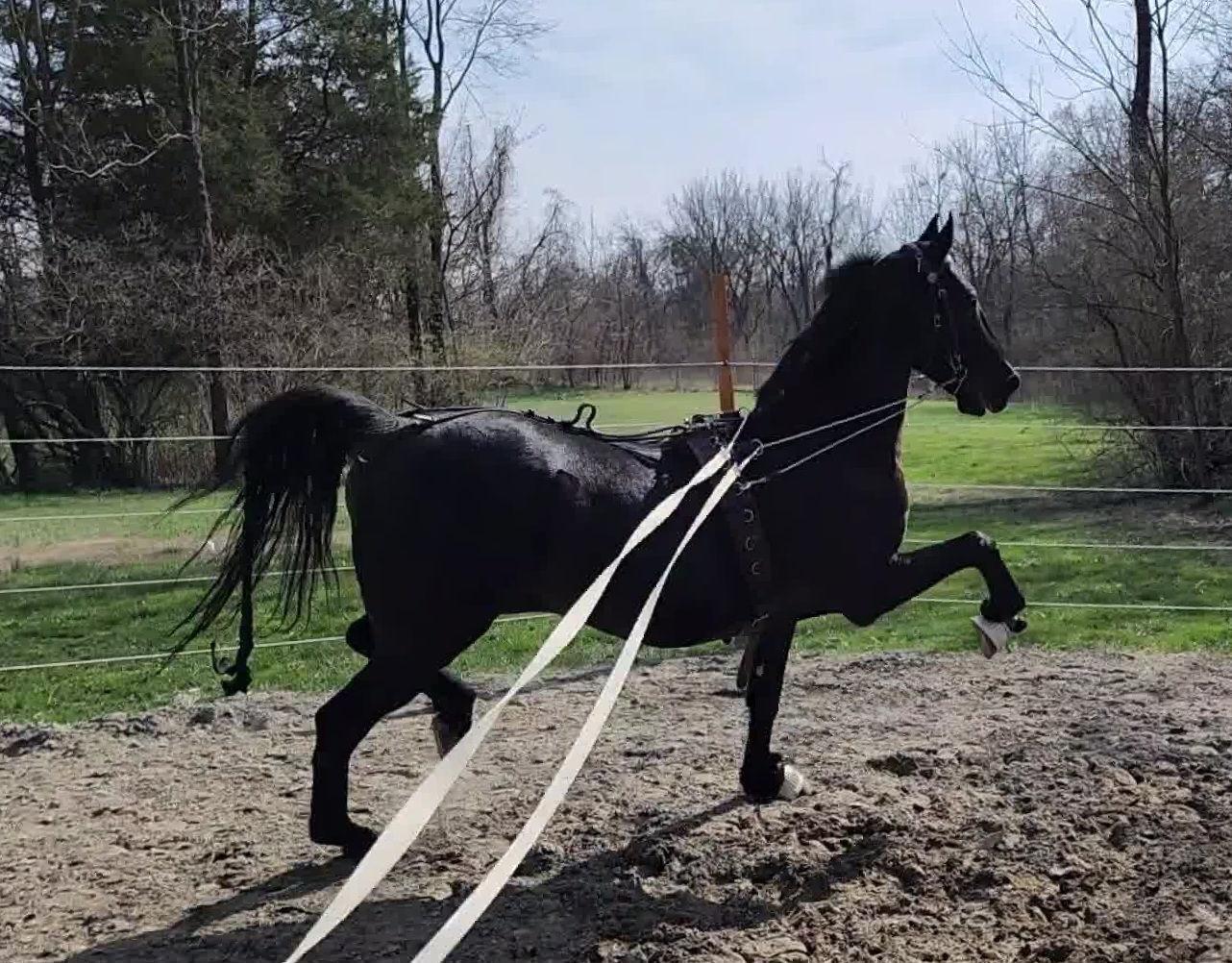
So, how do you do that? It’s easy. Same as you would do for yourself. Take the things you want to do, and start slowly by doing shorter, easier works at first. Gradually increase time and intensity as the days and weeks progress. Now, each horse will be different, the same as people. It could take one horse 2 weeks to get “back in shape” while another takes 2 months or even longer. Age, diet, attitude, and how they are kept day to day all play a role in how long it will take them and you have to treat each one as an individual. I like to start by doing mostly walk, a little bit of trot works on the lunge line for the first few days to get them back into the routine of doing something, but give them something that isn’t very hard to do at first. Next, I will add in long lines and work on bending, steering, body awareness, and contact. Once they are going nicely in lines and listening well to basic commands, I bump up the intensity and length of the sessions. Then I will add jogging with a cart to the mix a day or two a week (more on that below). Lastly, I will mix in full training sessions in the saddle once I feel they have built back up a nice amount of stamina and strength. I may saddle them up before that and try to do a light work, or a trail ride, but it’s not going to be intense 3 gait training.

Once they are going under saddle again, I like to remind them of leg aids and voice commands. My horses know these things, but it’s easy for them to forget when they haven’t been doing them consistently every day for months, so they deserve a little leniency when they don’t respond immediately, or they respond incorrectly and need a reminder of what the aid means. Practicing kindness and understanding goes a long way with the rapport you share with your mount. Rest assured, they will remember, you just have to give them a chance. It may not be on the first try, or the tenth, or the 50th, but keep your consistency and they will come around. My guys usually take several weeks of “reminders” to get back to what I consider appropriate responses and times.

I will also add in ground poles (at the walk) and trot work (on their aids) and do lots of transition work between walking/trotting, poles, and backing up. If you have access to hills, those are great at building strength and stamina and promoting proper movement, even if all you’re doing is hand walking them. I like to long line all around my property and the various terrain, as it gives my horses AND me a workout. Let’s face it, I could stand to have some exercise too after the holiday season and all the snacks my Mom made and I was forced to eat. Ok, fine, forced may be a little bit exaggerated but they were there and I just couldn’t let all her hard work or delicious treats go to waste, OK? Don’t judge me! 

If you have access to a jog cart and you and your horses know how to drive, pulling a cart is excellent for fitness and maneuverability. Plus, it helps to save their backs from so much riding, which I like. When my horses are in full work, I do drive them multiple times a week. Fizz knows how to canter pulling a cart, and it’s really helpful for him to still practice it without the weight of a rider. At the end of last season, I started teaching Duke, but then show season ended and they were turned out so I guess I’ll pick back up when we go back to work this year! My horses do prefer less riding sessions and more of other work, so I try to stick to their rules so that they are also enjoying our sessions. Fizz in particular gets really angry if all you do is ride. Duke is less particular, and will accept more days riding, but not until he’s been fully reminded of everything he knows via lunging, lining, and driving otherwise he will make your life a living hell.

Overall, I like to give them at least 60 days of consistent work to get back “in shape” before taking them to a show. Consistent work meaning 4-6 days a week. Now, sometimes this is possible and sometimes not, but that’s my goal.

Track Systems For Horses

I guess it was about 3 or 4 years ago when I first heard of a track system for horses, or a paddock paradise as some may call it. I thought it was an interesting concept, but didn’t really look much into it as I didn’t have horses at home at the time and had never really had experience with anything other than traditional turnout. Fast forward through 2023 where my 2 horses had promptly trashed both “rotating” pastures we had built. I mean literally, they destroyed them. Despite my rotating, despite fertilizing, despite reseeding, they were trashed to the point that most of what still grew was weeds. Early 2024, I had nothing but mud on at least half of both turnouts. GROSS. No one likes mud. Especially the boot sucking KY clay kind. No thanks.

Something had to be done, there HAD to be a better way. As I thought about potential remedies, I remembered seeing the “track system” or “paddock paradise” so I started to research. Turns out, there is a LOT to creating a horse oasis track system, BUT, it can make land management a lot less of a struggle. Especially for those of us not able to afford plenty of acreage suitable for horses. We have a total of 6.5 acres here, however as it turns out, not a lot of it is suitable for horses. Toxic trees, sink holes, flooding when it rains hard among other things plague part of our land but we do have a nice area that’s just big enough to give them room to run. And really, that’s all they need. Freedom, friends, and food.

So, basically the idea of a track system is to mimic the way horses would live in the wild. Roaming/moving constantly, foraging, moving over different terrains and having forms of enrichment they wouldn’t get in a traditional type of turnout. As I do with basically everything I’m interested in, I went down a rabbit hole of research looking into this and as with most things horses, there are die hard crazies, half-assers, and people somewhere in the middle. It’s enough to make a person lose their mind, but I’ve been around the horse industry long enough. I know how to ignore the loonies that scream “ABUSE!” at everything from bits to shoes to stalls and pretty much everything people do with horses, so I have been able to dive into this track thing and find my middle ground. Side note, no matter what you do with horses there are always going to be people out there who will tell you you’re wrong, you should/shouldn’t do this or that, etc. Well look here Karen, you do you mkay? We’re all doing the best we can with what we have. Move along.

Once I decided I’d give it a go, off to tractor supply I went to get a bunch of those cheap step in posts and put up a temporary “inner” fence. Since I had plenty of electric rope and accessories leftover from our last turnout build, I was set there. My husband was absolutely convinced these horses would NOT respect these, since they are much shorter than their (5 ft) permanent pasture fencing. Low and behold, they DO in fact respect it and it WORKED. I have kept it up all summer and it’s worked really well! Even when I wasn’t able to work the boys consistently, they never really lost much of their fitness level because they kept busy walking and running around outside instead of standing in one spot gorging themselves on grass.

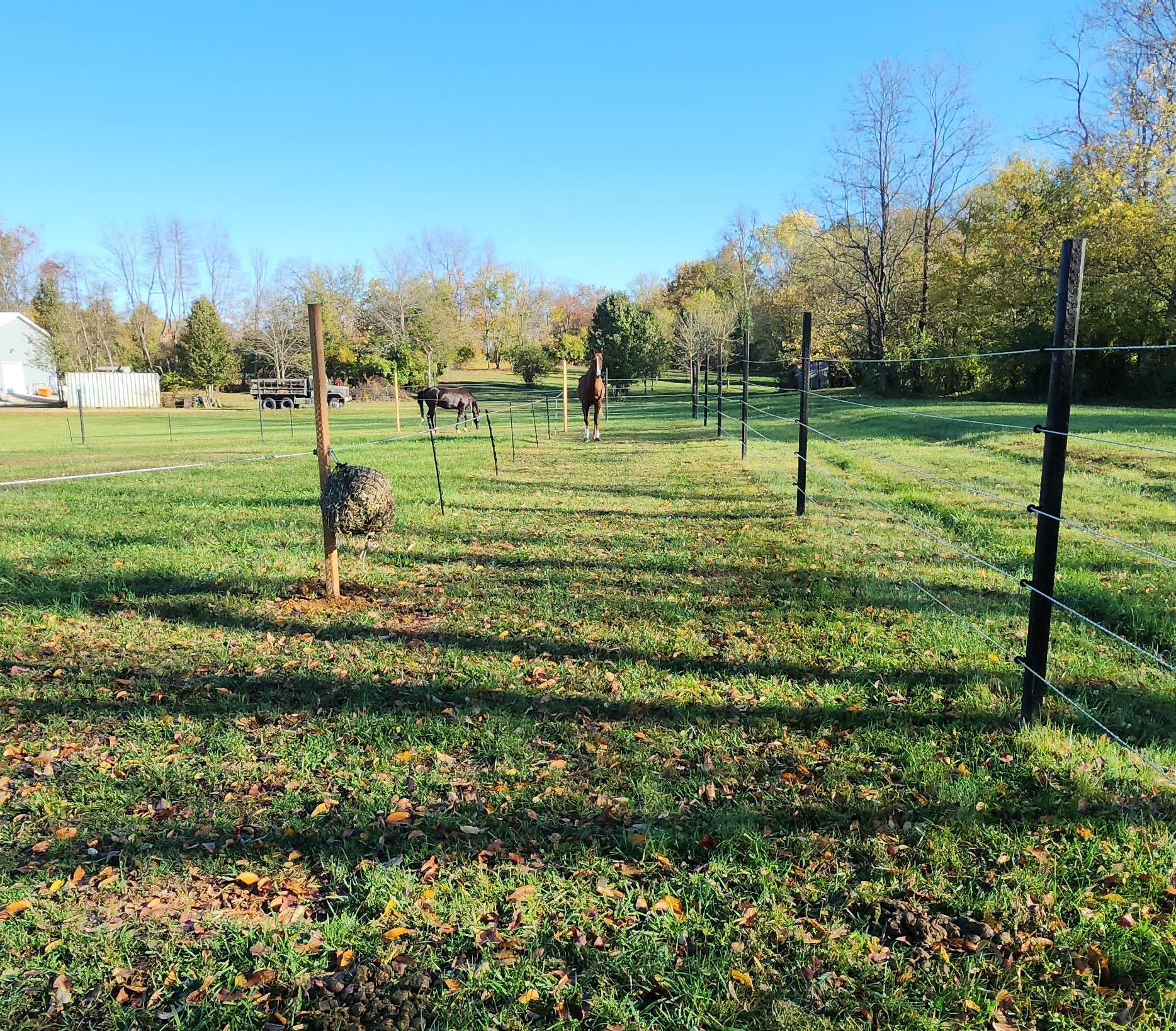
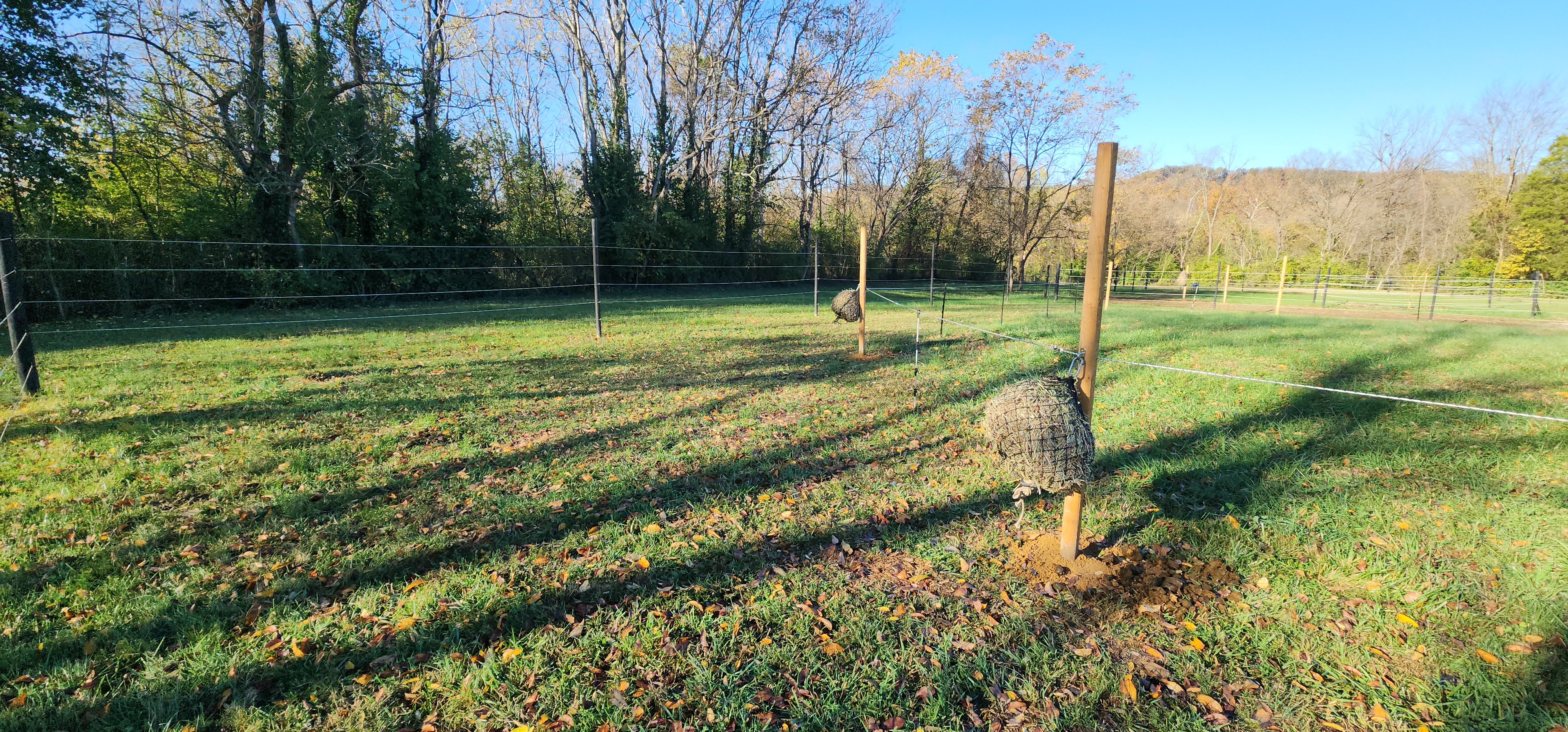
After having the temp inner fence up all spring and summer and seeing the benefits, we finally put in some permanent corner posts so the cheap step ins can just serve their “line post” purposes. Just to note, the temp posts aren’t without issue (they bend and then deform, badly, from the tension and sun and whatever) but they have served their purpose from early March to now (October). However, they worked really well to establish where I did want the more permanent fencing to be. Now that we have the permanent posts up, I was able to install electric gates to open/close as needed/wanted. Another added benefit to this is that I will be able to hang more hay bags from the new posts to encourage even more movement! I would love to add more features to the track, but for right now, we have what we have. With time and money, I’m sure more will come.

What are the benefits of a track system? Well, for starters:

  • Increased movement leading to better fitness even without work
  • Restricted grass intake (great for horses with cushings, history of laminitis, and other similar diseases)
  • More like the “natural” environment horses bodies were built for (more varied food sources, more long stem dry forage, less lush pasture)
  • Encourages natural behaviour (constant movement, foraging, herd environment)
  • Discourages vices (cribbing, weaving, etc)
  • Creates a stimulating, more interesting environment for the horses
  • Has many health benefits

While there are people who keep their horses out on their tracks 24/7 and swear their horses hate stalls and people who stall their horses are the devil, that’s great, I just don’t have the right land setup and facilities at this time to be able to do that. Would I like to one day? Maybe, but now isn’t that time. The boys are on track from sun up to sun down on all possible days, meaning it isn’t raining, isn’t icy or super slick, isn’t actively snowing, or otherwise garbage weather. There is no shelter in the fields/on the track and there is no good place they like to rest, so for us currently, bringing them in to their stalls at night is best. Unless someone out there stating I abuse my horses for “locking them up” wants to sponsor them a nice cushy shelter for their track so they have something, anything to block the sun/rain/wind, etc so I’d feel OK leaving them out. Until then, they will be in the barn in the shade under their fans during the hottest parts of the day, in their insulated stalls on the coldest nights, and out of the muck on the muddiest days. The rest of the time, they’ll be enjoying “track” life!

An overview map of the layout

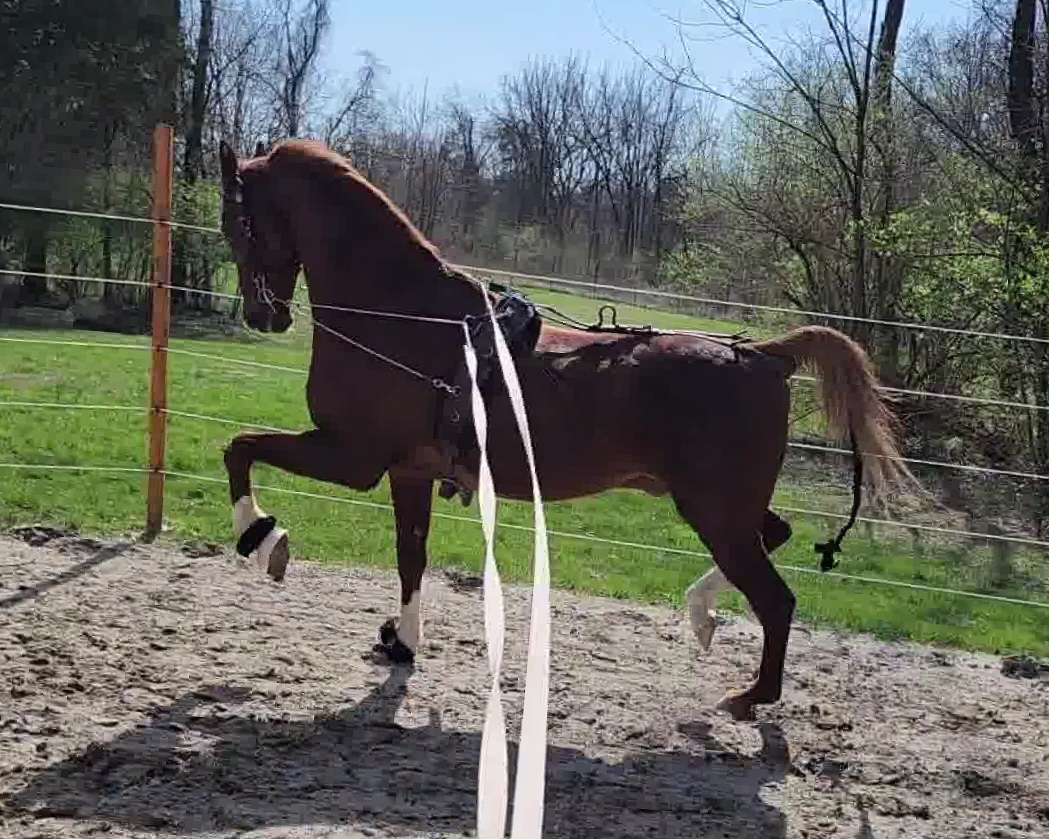
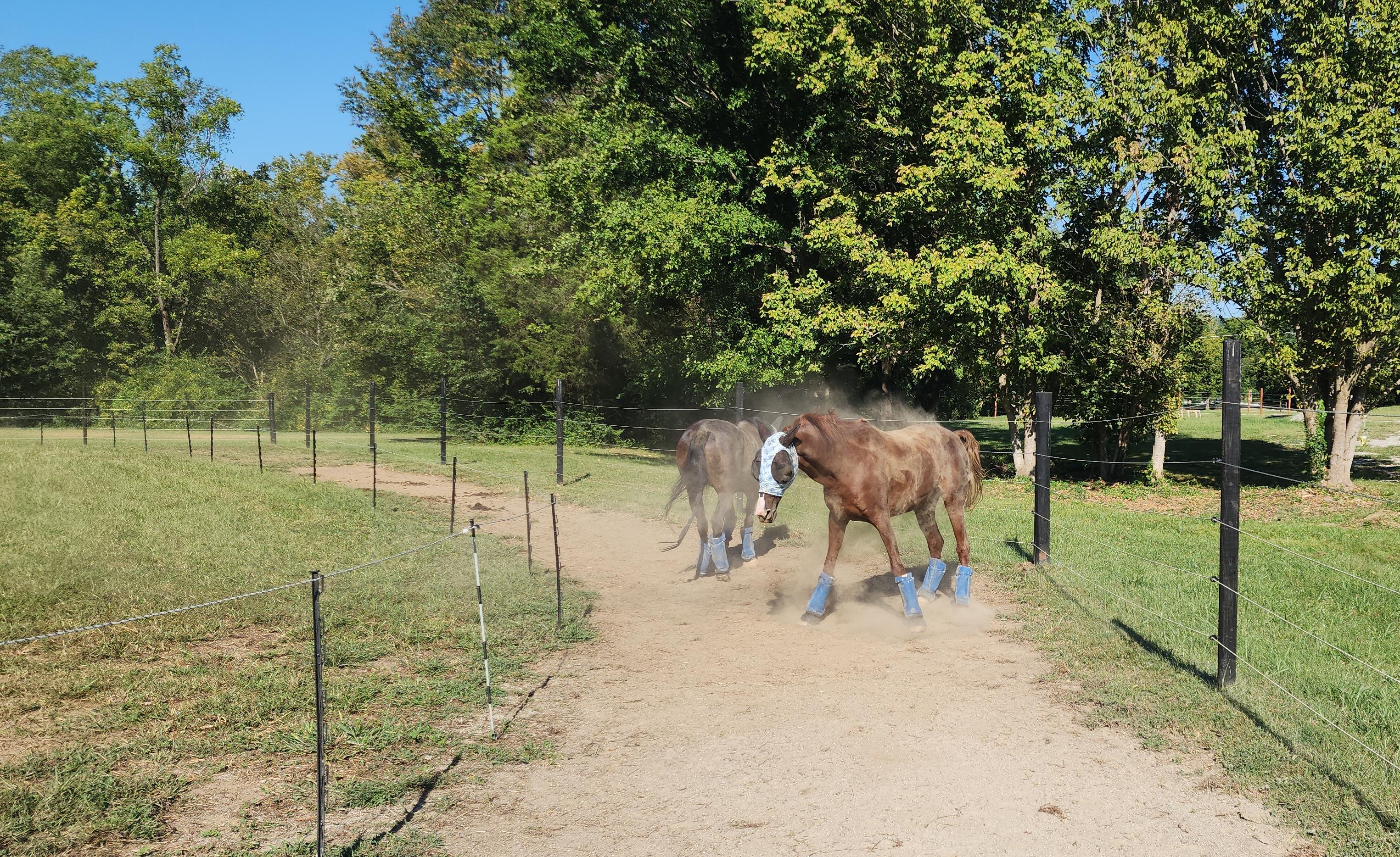
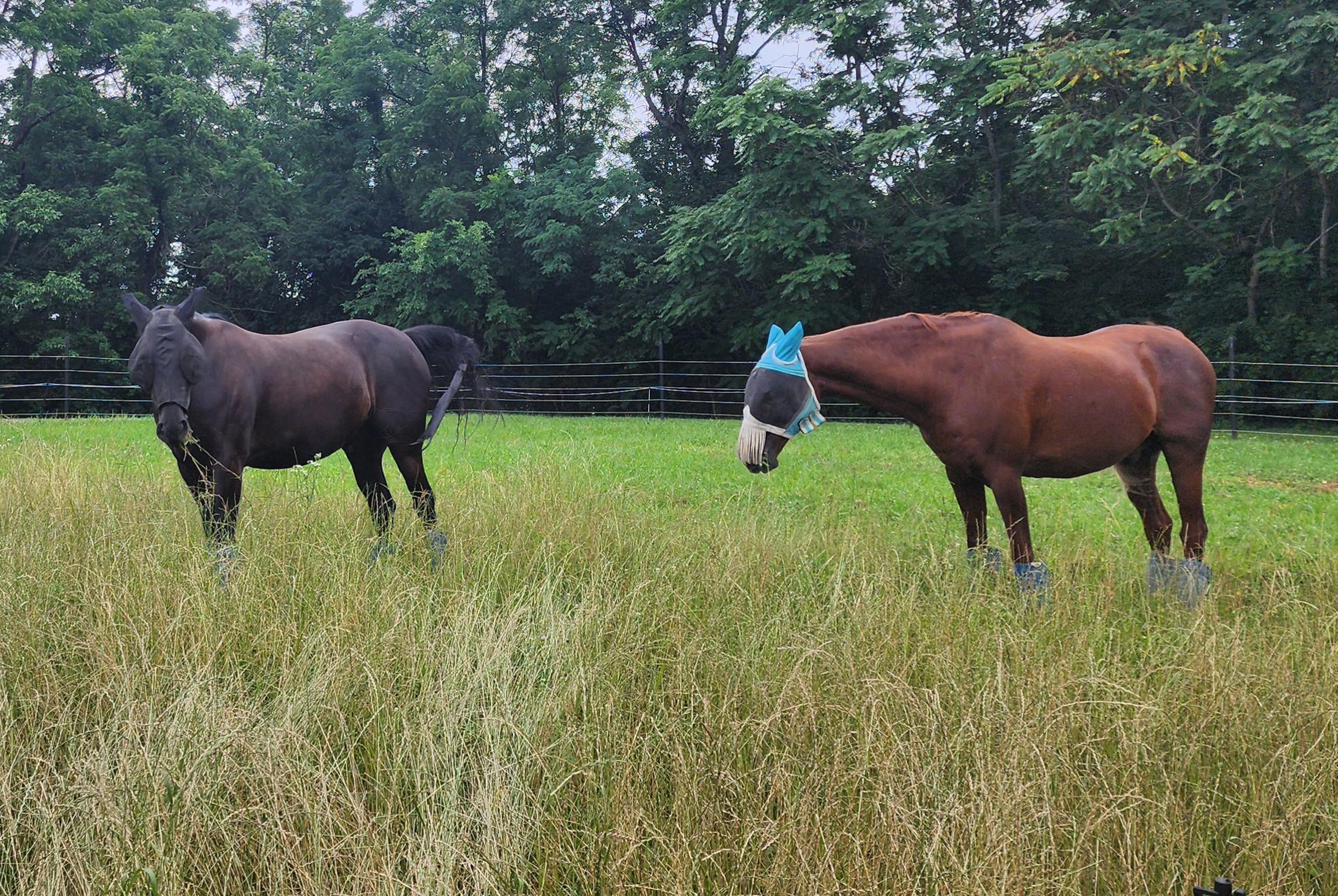
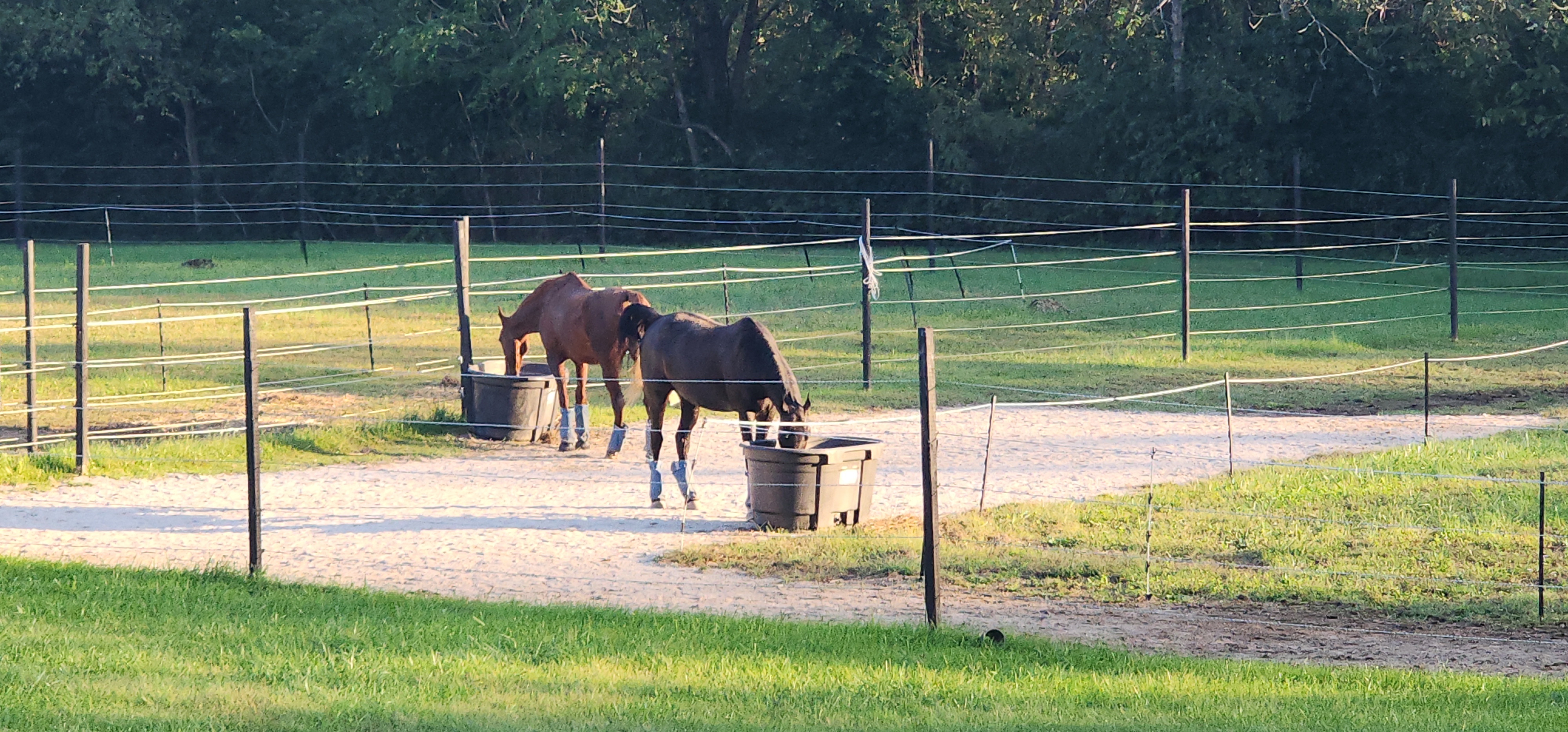
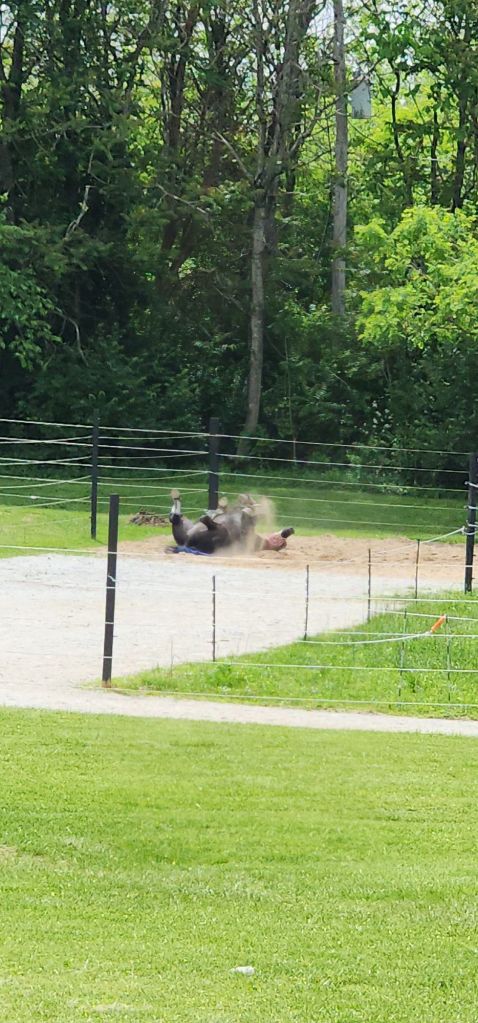
Here is a video and some photos of the boys enjoying their track. A few shots of them grazing the “middle” selectively where we have been able to grow much nicer grass than with them on it all the time! As you can see, the track portion has become pretty bare in a lot of spots, which is great since restricting the amount of access they have to lush grass is kind of the idea here.

Here are a few photos since putting in the permanent posts this week!

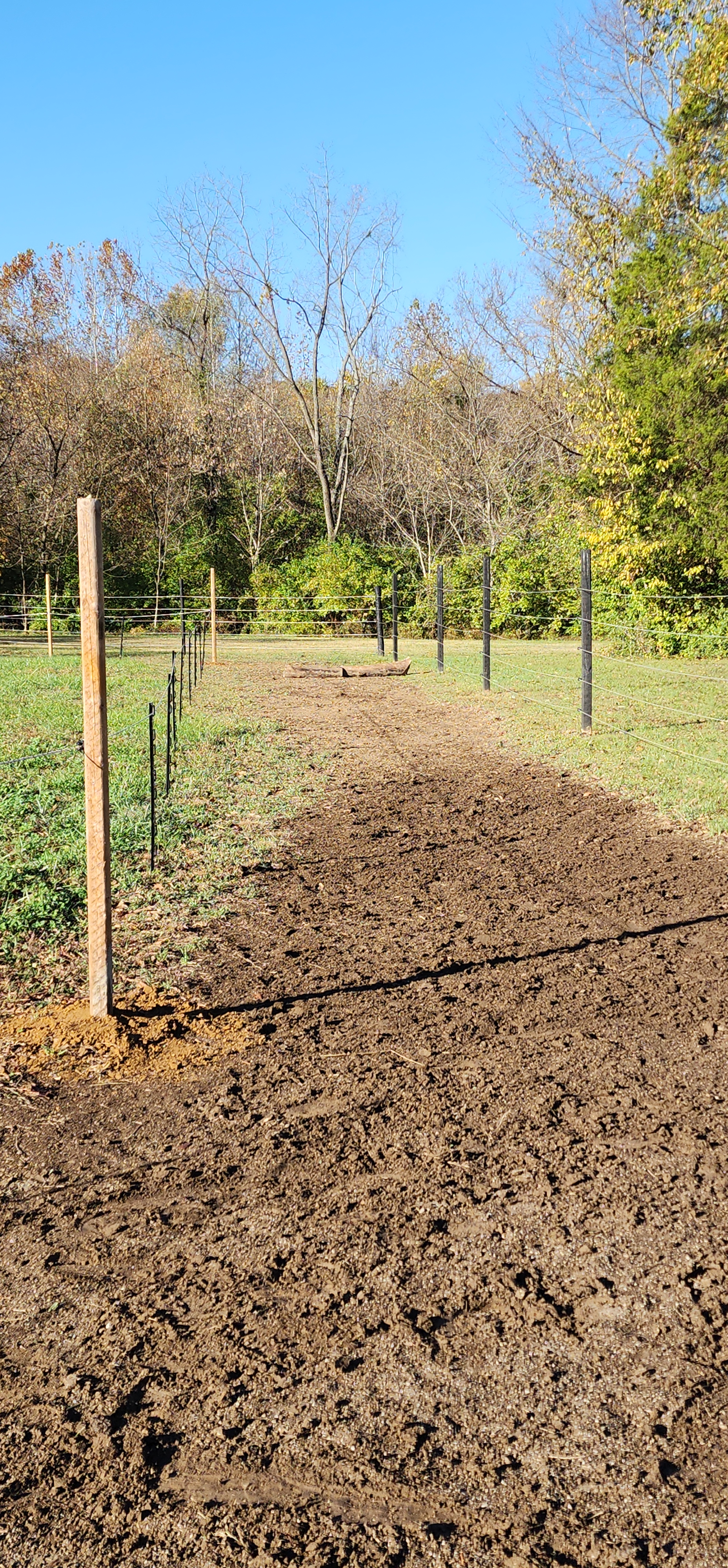
Here are some improvements including surfacing on the “front side” and a sand pit at the end of the hardatanding “square” plus some logs for them to navigate.  Next up is a scratch post going in very soon!

Hay in my Hair and Sweat in my Eyes

It’s been nearly 3 weeks since I pulled the trailer into our driveway with my boys in tow.

Since we are honest folk here at Twisted Sisters, I’m going to lay it out nice and clear for you. If you are a person who dreams of owning a horse and keeping it at home, and also believes doing so is full of nothing but butterflies, rainbows, and unicorn glitter, you are sadly mistaken and living in a dream world. Come back down from the clouds and join the rest of us here in reality. If you are perfectly clean and look like a million bucks all the time, you’re probably doing it wrong.

That aside, it is still in all reality, a dream come true for me. I take pride in hosting my horses in clean stalls, making sure they are fed, and that they always have clean water. If that means I pick stalls every time I walk by and see a pile of poo, so be it. I have that luxury where I didn’t used to and I am grateful for a life that has given me this opportunity. So I will do all the things and I will be happy that I have that luxury. A lot of folks do not. A lot of folks would love to. Some are happy to pay others for the dirty work, but I’m not that kind of gal. I have always dreamed of a life where I could be intimately involved in every detail of my horses care and I FINALLY have that opportunity. I would venture to say most truly hardcore equestrians dream of a life where they can spend it day in and day out doing all the “horsey” things, even the dirty ones. Either way… here’s my experience and things I have learned so far as a first timer having horses at home.

Helicopter Mom: Apparently, that’s me. I installed a camera to spy on the boys. I check it incessantly. If I wake up during the night, I look at it. If I hear a noise outside, I look at it, if I am working or busy and can’t walk outside just to see if they are OK, I look at it. I mean, in the last 2 weeks I have looked at the camera like I believe at any moment either horses legs may detach from their bodies or some other horrific thing might happen. What do I find? Them munching away on hay, looking outside, or laying down sleeping. Perfectly content with life. OR I find Fizz rubbing his tail, and I can scold him through the talk feature on the camera. Both horses now think God talks to them, below is them listening-they don’t know it’s just little ole me.

Hay: I am pretty sure there will never again be a moment in my life where I am not wearing hay as an added accessory to my outfit. It’s itchy and it gets in places no one should have hay, ever. How does it even get there? Does it grow legs and crawl to really weird spots inside your clothing? Just, how?? Also, if you like to watch your money turn to poop… Just look at your horses happily munching on hay.

Sweat: It’s summer here in Kentucky. It’s HOT and it’s HUMID. I spend a lot of time outside and always have but when you’re working with horses it seems like the heat is amplified 10 fold. I can’t explain why. My eyes have never burned so much as in the last several weeks. I think I’ll keep this as opposed to frozen fingers, but still. I am pretty disappointed I’m not skinny yet after all of this sweating. The universe owes me an explanation on this.

Poop: So much poop. Like, I realize they are large animals and I have worked jobs where stall cleaning was a part of it (back in college and as a kid) but there is SO MUCH POOP. Literally they are poop factories. How did I not remember this? And I feel for all of you who have barns full of horses because just these two create so much!!!

Dust: There is literally so much dust. I use a combination of pellet bedding and bagged shavings, which I had read this combo was supposed to be low on dust. I would like to know what definition of “low dust” is on the internet because this is not it. Therefore, I have been researching this. Evidently, I need to “water” my stalls. Um, excuse me? I don’t even water my flower beds. Those things need to live off the water God gives them or they don’t survive well here. Somebody send help.

Crisis: If you think you’ll never feel like you are in a crisis, just give it a minute-one will come and your little fantasy bubble will have been popped. If you have thought about it and planned for every crisis you could think of (like me) and think you know how it will go, just know it goes nothing like you thought it would. Also know that of all the crises you could think of, the one that will happen is something you NEVER thought of. There’s a back story here I might visit later, but my first “crisis” was experienced and it is over now. Bless my husband, my friends, and my very lovely Vet for putting up with me. I probably worry way more than I should.

Bills: There are just SO many bills. Hay, grain, bedding, vet, farrier, supplements, and the list goes on and on and on into eternity. Some bills can be more than you expect, by a LOT. You might think about finding a street corner to call your own, but in the end you’ll do whatever it takes to make sure your horses are healthy and happy. Even if that might mean eating ramen and never leaving your house again.

Help: Having help is CRUCIAL. I can’t say this enough and to those of you out there doing it by your very lonesome, what kind of super hero DNA do you have and where can I get some of it? Or are you just an alien with weird superpowers I can’t even begin to imagine? Because I would NOT have made it even these last few weeks without my poor non-horsey husband who has gotten a very rude intro on how to restrain a contrary horse, how to work a twitch, and some of the other unpleasant things things that come with being around horses. He has also been learning how to pick stalls and he does so without even being asked. BLESS HIM. Ladies, a lot can be said for a man who isn’t into horses but cleans stalls without asking simply because he knows YOU want your horses living in the cleanest stalls in America. I would also not have survived without my Mom, who comes over simply to make sure I don’t die while working these creatures. She’s a saint.

Work: Having horses at home is work. I work a real big girl job. I spend every other amount of time doing things for the horses and the dog. What exactly is this “spare” time everyone speaks about? Who exactly in this world gets to “sleep in” because yeah, that’s not a thing here (for me). Everyone else is taken care of before me. I am the last to eat, the last to be clean(ish-you know, because hay exists…), and I’m fairly certain the horses stalls are cleaner than my house. I can barely manage to do something as simple as boil noodles and slap sauce on top for dinner most days. Dishes left in the sink? Oh well, maybe I’ll get to those tomorrow. Or not. As long as the 4-leggeds are taken care of those dishes can sit another day. Paper plates? Meals that don’t require silverware? Even better. Sign me up.

LOVE: These animals have so much love to give. They make me laugh daily and they fill my heart with so much joy despite all of the above. I truly enjoy simply watching them exist day to day. Every person has good day and bad days, and I believe all creatures do. Our job as humans and facilitators of these animals is to make sure their days are all as good as possible, and understanding that they too, have days that are “off” and they deserve our compassion and understanding. No one, and no animal, is perfect all day every day. These horses (and our Dog Dixie) give me a break when they know I’m having an off day. They offer me peace and acceptance, despite my shortcomings. The least I can do is offer them the same.

Update on Fiz’s training!

Fiz has been at a professional trainer since March 25th. He’s there almost through the end of April. There have been some big changes in his life during this time period. He is used to living in a pasture, and only coming in to work, then going back out. He lives in a stall the majority of the time at the trainers place. He is used to being worked only about 4 days a week. He is getting worked 6 days a week at the trainer. He’s used to amateurs who fly by the seat of their pants and lack professional training knowledge. Now he’s being worked by a professional who has a clearly defined training method and structure.

Today, April 14th, he’s been with the trainer for about 2.5 weeks. I got to ride him for the first time since he has been there. Cindy rode him on Saturday, and had a really great ride. I would like to talk about some of the things I noticed with her ride, and some of the things I learned during mine. I will also talk about some of the training advice we have gotten and how it differs from the ideas we previously had.

First, let me say this. He is much improved in several areas. Below, I’ll take you through the gaits and what advice has been offered for each.

#1, The Walk
Flat, straight, and patient. Make him walk straight up into the corners and make the arena square. Make his shoulders and his hips walk inline with each other, and make sure as you are walking to push him up to the bridle so he has to take ahold of it. Do not pull. Hands steady, and in the same spot. When he takes hold, give. Just a small release of your fingers, but keep pushing with your leg making him walk up to the bit.

#2, The Trot
A country pleasure horse needs 2 trots. The pleasure trot and extended trot. We knew this, but previously Fiz would get mad when he was asked to go faster and he would break into a canter without ever actually going faster. It’s better to have only one speed than have to break, so that’s what we used to do.  A pleasure trot needs to have energy, it needs to cover ground, but it also needs to save room for max trotting speed at the extended trot. Same principles apply as the walk, use a lot of leg, push him to the bridle and make him take hold as he moves forward. Music to my non-equitation body type and mind frame was, let your legs hit him in the sides and even flop around on him some. Apply pressure, keep him moving forward and pushing from the hind end. He is expected to move from the back to the front, pushing off his hind to give his front momentum. Always keep the whip right against his shoulder.

When you ask for the extended trot, cluck, then squeeze (don’t kick) and if he doesn’t move on, give a slight tap with the whip on his shoulder. Not a whack, a TAP. If that doesn’t do it, growl at him and tap again. He has learned that he has to move on and not break into the canter. That doesn’t mean he will never break. If he does, don’t stop! Keep cantering. Teach him that it’s more work to do the wrong thing than the right. Rest assured, he will find his trot after enough of making him go and go, and you will find the sweet spot where you have hit max trotting speed before he has to canter. If you really want to find good separation, work him at a pleasure trot, then extended trot, and bring him back down to a pleasure trot. Even if just for one rail, you try to find that max speed, really ask him to step up, then come back down to the pleasure trot. Keep the energy and the go forward all the time. Do not forget about contact with his mouth (keep this in mind at all gaits) and do not forget that reward of giving when he takes a hold on his bridle and moves on forward. Always give him that reward.

#3, The Canter.
His canter cues are more clearly defined and he is learning the expectation for getting and keeping the correct lead both directions of the ring. Previously, we thought each time he took it wrong, we should stop and ask again until he got it right. This method had taught him if he does it wrong, he gets to quit. The new method is, no matter which way he takes it, do not let him stop. Make him GO. And go, and go some more. Teach him that just because he does something wrong, he does not get to stop and quit. He’s working no matter what he does, and again, it’s going to be harder when he does it wrong.

The canter cue needs to be very clear. A slight turn of the head (bring the rail rein straight back and at the same time give with the inside rein with a release of your fingers), rail leg, and SPEAK the word “Canter” to him. Speak the word EVERY TIME you ask for the canter. Do not be afraid to be vocal. IF he runs sideways when you turn to canter, DO NOT let him canter. This is unacceptable behavior that will be punished by forcing him back to the rail and to walk straight, and patiently, until he is asked again for the canter with the clear signal. This could mean setting him up to canter multiple times, but never allowing him to actually take off. Set up to canter and then go back to straight walking forward on the rail until he doesn’t get all sideways and crooked. Then maybe trot. Do anything else so he loses the train of thought to anticipate cantering.

When cantering, he is capable of cantering SLOW.  Take back on the upward motion, and give on the downward motion.  Give and take, constantly.  And still, SAY the word CANTER, or make a “kiss” sound to him.  Make him canter straight, and do not let him swing his back end to the middle, because this makes it easier for him to swap leads.  If anything, turn his head more toward the middle so it makes it more difficult for him to swap leads or fall out of the canter.  When he does it right, don’t push the issue or make him keep on going. Maybe one or two trips around is good, then quit on a good note.  Remember, make it EASIER to do the RIGHT thing.

12140048_10154166158764444_2067037096436532418_o

Bottom line is, he’s going to make mistakes. The most important thing is to teach him that it’s easier on him to do right than to do wrong. Bad behavior is punished by harder work. Good behavior is rewarded by giving (releasing your fingers) in the bridle and getting to be finished sooner because he did everything you asked and he did it correctly.

Always ask yourself the question: “Am I training or am I un-training?” and if you are not certain, it’s probably the latter. If you can answer that you are training, follow up with “What is this teaching him?” and as long as you are happy with what it is teaching, stick with it. If you’re not, change it up. Think ahead, have a plan, and execute that plan.
Another thing we’ve been taught is that he needs to jog. And jog, and jog, and jog. The more fit he is (which is accomplished by miles and miles in the jog cart) the easier it is going to be for him to do the right things, the easier it will be for him to be able to willingly go forward and move on. We can’t ask him to run a marathon when he’s been working as a sprinter.

Check out this video clip after his first week of training.

A Short Video from Professional Training

Happy 5th Birthday Fizzy!

Most people probably think we are insane for celebrating our horse’s birthday.  We took the opportunity to combine Fiz’s 5th birthday (July 27th 2013) with Kayla’s 30th birthday (July 28th 2013) and have a nice little party at the barn.  We had a nice turnout and good times were had by all.  Fiz and his friends enjoyed the birthday cake made from molasses and grain, carrots, and apples.